Last updated: August 2026
Italy’s logistics and transport sector is short of qualified drivers, and that gap is opening real doors for job seekers — both Italian nationals and workers relocating from abroad. Whether you’re searching for company driver jobs in Italy for the first time or comparing offers between logistics firms, courier companies, and manufacturers with in-house delivery fleets, this guide walks through what these roles actually pay, what licenses and documents you need, and how to apply the right way.
This article draws on labor-market data from Glassdoor and ERI SalaryExpert, and on Italy’s official 2026–2028 Decreto Flussi immigration framework, so you’re working from real figures rather than guesswork.
What Does a “Company Driver” Do in Italy?
A company driver (autista aziendale) is employed directly by a business — rather than working as an independent contractor — to transport goods, equipment, or sometimes staff on the employer’s behalf. In Italy, this umbrella term covers several distinct roles:
- Delivery drivers (autisti consegne) — last-mile delivery for retail, e-commerce, or food-service companies, usually using vans.
- Truck drivers (autisti di camion / autotrasportatori) — regional or long-haul freight transport, typically requiring a Category C or CE license.
- International/HGV drivers — cross-border freight within the EU, often the highest-paid tier due to travel allowances.
- Fleet or company car drivers — driving executives, sales staff, or company vehicles for corporate clients.
- Warehouse-to-store drivers — internal logistics roles for manufacturers and distributors.
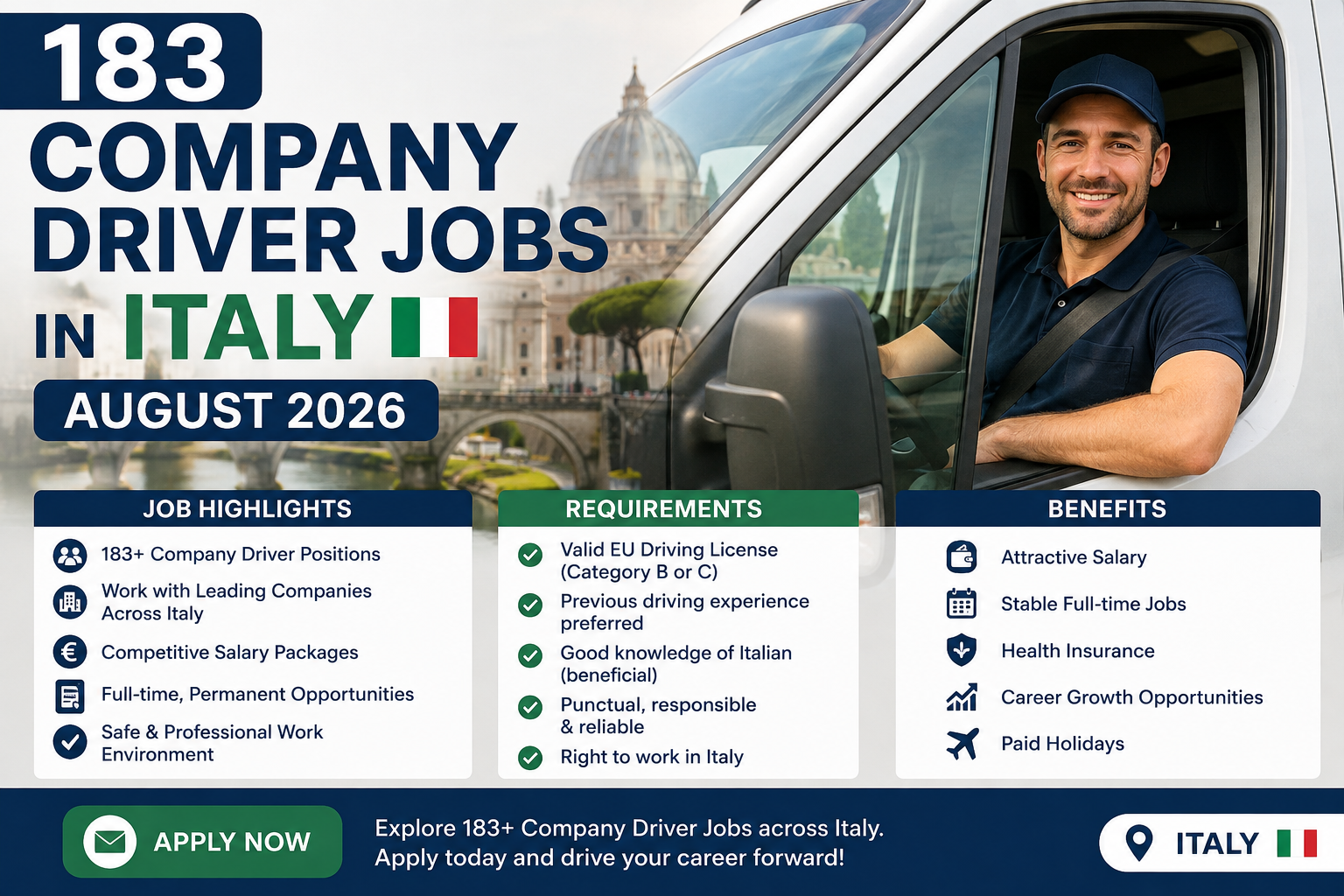
Job boards such as Glassdoor currently list well over 180 open company driver positions across Italy at any given time, spanning logistics companies, regional distributors, and manufacturers with their own delivery fleets.
How Much Do Company Drivers Earn in Italy in 2026?
Driver pay in Italy varies significantly by vehicle type, route (domestic vs. international), region, and years of experience. Here’s what current salary data shows:
| Driver Type | Average Annual Salary (Gross) | Entry-Level | Senior (8+ yrs) |
|---|---|---|---|
| General/Company Driver | ~€21,000–€22,000 | ~€16,500 | ~€22,900 |
| Truck Driver (HGV) | ~€34,900 | ~€25,700 | ~€38,500+ |
| Heavy Truck Driver | ~€36,000 | — | up to €43,000 |
| International Long-Haul Driver | €37,000–€45,000+ | — | — |
A few things worth knowing about these figures:
- Recent 2026 salary survey data puts the average truck driver salary in Italy at roughly €34,900 a year, or around €2,900 a month.
- Senior drivers with more than eight years of experience — particularly those on international routes or in specialized freight — can earn €37,000 to €45,000 or more.
- Milan pays the highest truck driver salaries nationally given its role as Italy’s logistics and economic hub, though the cost of living there is also higher. Bologna, Turin, and Verona offer competitive pay with lower living costs.
- Northern regions such as Lombardy, Emilia-Romagna, and Veneto tend to pay the most because they’re industrialized and sit on major European trade routes, while southern regions offer lower pay alongside lower living costs.
- General company drivers with 1–3 years’ experience average around €16,500, rising to about €22,900 for those with 8+ years.
Bottom line: if you’re comparing offers, don’t just look at the base salary. Ask about mileage allowances, per-diem rates for overnight or international routes, overtime rules, and whether fuel and vehicle costs are covered — these can add several thousand euros a year for long-haul roles.
Requirements to Become a Company Driver in Italy
1. The Right Driving License
Italy uses the standard EU license category system:
- Category B — covers cars and small vans (up to 3.5 tonnes). Sufficient for many delivery-driver roles.
- Category C — required for rigid trucks over 3.5 tonnes.
- Category CE — required for articulated trucks/trailers, the standard for long-haul freight.
- CQC (Carta di Qualificazione del Conducente) — a mandatory professional driving qualification card for anyone driving commercially in Category C/D vehicles, on top of the license itself.
EU nationals can generally use or convert their existing license and CQC once resident in Italy. Non-EU nationals typically need to obtain an Italian license after a period of residency, though some bilateral agreements allow direct conversion depending on your home country.
2. A Clean Driving Record
Employers routinely check driving history and any pending legal charges. A clean record — free of DUI or reckless-driving infractions in particular — is close to non-negotiable for company driver roles, especially those involving company-owned vehicles and higher insurance liability.
3. Language Skills
Basic to conversational Italian is expected for most roles, since drivers need to read road signs, communicate with dispatch, interact with clients, and complete delivery paperwork. Some multinational logistics firms and international-route positions accept English-speaking drivers, but this is the exception rather than the rule.
4. Work Authorization (For Non-EU Applicants)
This is the part most international applicants get tripped up on, so it’s worth covering in detail below.
Can Non-EU Citizens Get Company Driver Jobs in Italy?
Yes — but the path runs through Italy’s official immigration quota system, not a direct job application the way it might work for EU citizens.
Under Italy’s Decreto Flussi framework for 2026–2028, nearly half a million work permits for non-EU workers are being allocated over three years across key sectors including transport, agriculture, construction, and manufacturing. For 2026 specifically, roughly 165,000 permits have been allocated to help address labor shortages, transport among them.
Here’s how the process generally works:
- You need a job offer first. To apply under the Decreto Flussi, you must already have a job offer from an Italian employer (or a legally resident foreign employer). You cannot initiate this permit process on your own.
- The employer files the paperwork. The process is employer-led — an Italian employer must apply for a work authorization known as the Nulla Osta through the Sportello Unico per l’Immigrazione (the regional immigration desk).
- You then apply for the visa. Once the Nulla Osta is approved, you apply for an entry visa at the Italian consulate in your home country.
- Register on arrival. After arriving in Italy, you have 8 working days to apply for the permesso di soggiorno (residence permit) at the local Questura. End-to-end processing typically takes anywhere from 60 to 180 days depending on category, region, and quota timing.
Practical takeaway: if you’re outside the EU, focus your job search on Italian logistics companies with a track record of sponsoring foreign drivers under the Decreto Flussi quota, and plan for a multi-month timeline rather than an immediate start date. Highly qualified drivers with strong salary offers may also want to ask a prospective employer about the EU Blue Card route, which requires an annual gross salary of roughly €38,000 and offers a faster, quota-free path for qualifying senior roles.
Where to Find Company Driver Jobs in Italy
A few reliable starting points:
- General job boards: Glassdoor, Indeed Italy, and LinkedIn regularly list company driver openings. Glassdoor’s Italy driver listings are a good place to see current openings alongside employer reviews and reported salaries.
- Sector-specific portals: Sites focused on logistics and transport (regional autotrasporto job boards, for example) often list roles that never make it to general job boards.
- Direct company applications: Large retailers, food distributors, and manufacturers with in-house fleets (supermarket chains, beverage distributors, courier companies) often hire directly rather than through agencies.
- Staffing and recruitment agencies: Agencies specializing in logistics placements can be especially useful for non-EU applicants, since some actively manage the Decreto Flussi sponsorship process on behalf of employers.
When comparing listings, check whether the role is described as dipendente (direct employee) versus a freelance/VAT-number (partita IVA) arrangement — company driver roles specifically imply direct employment, with the tax and benefit protections that come with it (INPS contributions, paid leave, sick pay).
Tips for Standing Out as a Company Driver Applicant
- Highlight your license category and CQC validity dates clearly on your CV — employers scan for this first.
- List specific vehicle types and route experience (urban delivery, refrigerated transport, international freight) rather than just “driving experience.”
- Mention your language ability honestly. Overstating Italian fluency creates problems fast in a role built around communication with dispatch and clients.
- Get familiar with digital tachograph rules and EU driving-time regulations if applying for HGV or international routes — these come up in interviews.
- Ask about the full compensation package, not just base salary: per-diems, overtime, vehicle assignment, and health coverage all vary widely between employers.
Frequently Asked Questions
How much does a company driver earn in Italy? General company drivers average around €21,000–€22,000 a year, while truck and HGV drivers average closer to €34,900–€36,000, with senior international drivers earning €37,000–€45,000 or more.
Do I need a special license to be a company driver in Italy? It depends on the vehicle. Category B covers cars and small vans, while Category C or CE is required for trucks, along with the CQC professional driving qualification card.
Can foreigners get company driver jobs in Italy? Yes, but non-EU citizens need an Italian employer to sponsor them through the Decreto Flussi work-permit system, which requires a job offer before any visa application can begin.
Is Italian language ability required for driver jobs? For most roles, yes — at least conversational Italian is expected, since drivers interact with dispatch, clients, and delivery paperwork daily. Some international-route or multinational-employer roles are more flexible.
Where can I see current open positions? Job boards like Glassdoor list active company driver openings across Italy, including salary estimates and employer reviews from current and former drivers.